
Most rebrands are commissioned in a moment of frustration. Growth flattened. A competitor with a worse product is winning. The deck feels embarrassing. The instinct is to blame how the company looks.
Sometimes the instinct is right. Often it isn’t, and the money goes out anyway. Founders who skip these decisions do not get a bad brand. They get an expensive one that changes nothing.
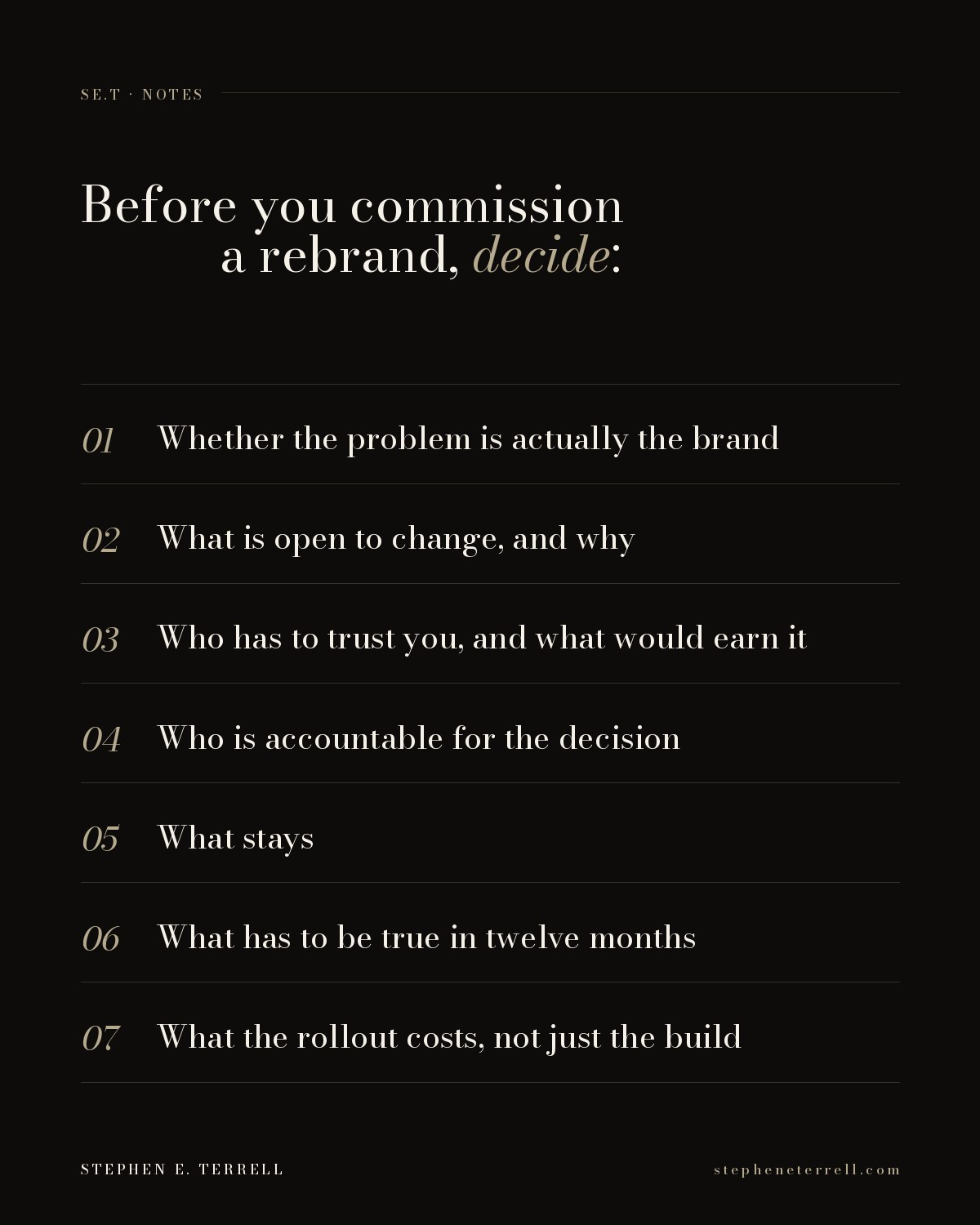
Here is the order I work in.
1. Decide whether the problem is actually the brand
Ask a harder question than “does our brand look current.” When a qualified buyer walks away, what did they say?
If buyers don’t understand your offer, investigate positioning and narrative. If they choose someone cheaper, find out whether they couldn’t see your value or simply couldn’t afford it. Those are different problems.
Diagnose before you redesign.
2. Decide what is open to change — and why
You may keep the name and every recognizable visual asset while fundamentally changing the promise. What matters is whether the work addresses the business problem, not how much of the identity moves.
So write it down before anyone pitches you: the name, the category you compete in, the segment you serve, the promise you make, the thing you are famous for, the founder’s face. Which of those is genuinely on the table? If none of them are, say so out loud. You will save six weeks and a lot of goodwill.
3. Decide who has to trust you, and what would earn it
This is the decision that determines everything downstream, and it is the one founders delegate most often.
Not who is our audience. Who specifically has to believe you before money moves, and what is standing in their way? Fear? Confusion? A bad experience with someone who came before you? An industry reputation you inherited but did not create?
I spent more than two decades building brands in life settlements, a category where the product was legitimate, the decision was unfamiliar, and bad operators had done real damage to public trust. The people we needed to reach were not skeptical of us. They were frightened of the whole subject, and they were being asked to make a significant financial decision about their own mortality.
Credibility mattered, but we first had to make people comfortable enough to listen. I proposed Betty White because her warmth and familiarity could help open that conversation. She was the company’s spokesperson for a decade, and she became the centerpiece of everything we did.
That was not a celebrity decision. It was an audience decision that happened to have a celebrity as its answer.
Get this one wrong and the identity that follows will be beautiful and inert.
4. Decide who is accountable for the decision
Name one accountable decision-maker. Gather leadership input and establish any board or compliance requirements before creative begins.
Brands die in consensus. Every additional approver moves the work toward the average of everyone’s comfort, and the average is never distinctive. The protection against that is not fewer stakeholders — it is agreeing on the criteria for approval in advance, so feedback tests the strategy instead of collecting personal preferences.
5. Decide what stays
Do an equity audit before you throw anything away. There is almost always something the market already recognizes and rewards you for. A name customers say out loud. A colour that owns a shelf. A line someone else quoted back to you. A founder story that opens doors.
Founders are the worst judges of this, because they are bored of their own brand years before their customers are. What exhausts you may be the only thing working.
In 2009 Tropicana replaced the orange-and-straw image on Pure Premium with a glass of juice. Shoppers stopped recognizing the carton on shelf. Ad Age, citing IRI data, reported unit sales down 20 percent between January 1 and February 22; the company announced the reversal on February 23. The design wasn’t bad. The decision was — nobody had established what the market was actually using to find the product.
Decide deliberately what survives the rebrand, and then defend it.
6. Decide what has to be true in twelve months
A rebrand without a stated outcome cannot succeed, because nothing was defined as success. “Modern” is not an outcome. “Premium” is not an outcome.
Pick two or three things you will actually watch: how long it takes a prospect to understand what you sell, the quality of inbound rather than its volume, win rate in competitive deals, the caliber of people who apply to work for you, whether you can raise price. Write them down before the work starts, while you are still honest.
7. Decide the launch budget, not just the build budget
The fee to develop the brand is only part of the investment. Budget for putting it into use across the business: the site, the sales materials, signage, packaging, templates, trade presence, the internal work of getting your own people to use the new language, and enough noise at launch that the market notices a change occurred.
A rebrand with no rollout money behind it reads as indecision. Half the assets are new, half are old, and the market concludes you are unsure. Decide the full number before you commission the first phase.
The question under all seven
Are you prepared to become something slightly different from what you are today?
If the honest answer is no, you do not want a rebrand. You want better execution of the brand you already have, which is a real and worthwhile purchase, and a much smaller one. There is no shame in buying that instead.
If the answer is yes, then commission the strategy before the design, settle these seven while the stakes are still theoretical, and hire someone who will make you answer them.
The look is the last decision.It is also the only one anyone argues about.Make the other six first.
Sources: the Tropicana figures are from Advertising Age, April 2, 2009, citing Information Resources Inc. data for January 1 to February 22, 2009. The Betty White spokesperson relationship is recorded by the company in its Business Wire release of January 13, 2014.
What must a founder decide before commissioning a rebrand?
Seven things, and none of them are visual: whether the problem is actually the brand, what is open to change and why, who has to trust you and what would earn it, who is accountable for the decision, what stays, what has to be true in twelve months, and what the rollout costs beyond the build.
How do you know if you need a rebrand or just better execution?
Look at why qualified buyers walk away. If they do not understand the offer, the problem is positioning and narrative, and a rebrand is the right instrument. If they chose someone cheaper, establish whether they could not see the value or could not afford it. Those are different problems with different fixes.
Who should approve a rebrand?
One accountable decision-maker. Leadership input, board requirements and compliance review should be gathered before creative begins, and the criteria for approval agreed in advance, so feedback tests the strategy rather than collecting personal preferences.
How much does a rebrand cost beyond the design fee?
The fee to develop the brand is only part of the investment. Budget for putting it into use: the website, sales materials, signage, packaging, templates, trade presence, internal adoption of the new language, and enough launch visibility that the market registers the change. A rebrand with no rollout budget reads as indecision.
Can a rebrand keep the existing name and logo?
Yes. A meaningful repositioning can preserve the name and every recognizable visual asset while fundamentally changing the promise. What matters is whether the work addresses the business problem, not how much of the identity changes.
What is a brand equity audit?
An inventory of what the market already recognizes and rewards you for before anything is discarded — a name customers say out loud, a colour that owns a shelf, a line someone quoted back to you, a founder story that opens doors. Founders are the worst judges of this, because they tire of their own brand years before their customers do.
Why did the 2009 Tropicana redesign fail?
Shoppers stopped recognizing the carton. Ad Age, citing IRI data, reported unit sales down 20 percent between January 1 and February 22, 2009, and the company announced the reversal on February 23. The design was not bad; nobody had established what the market was using to identify the product on shelf.